
World Bee Day on 20th May offers a gentle reminder that our towns and cities don’t just need to work for people – they need to work for pollinators too.
Pollinating insects, including bees, hoverflies and moths, are vital for the reproduction of up to 90% of wild flowering plant species and many crop species, yet studies across Britain show widespread losses in wild bee and hoverfly species.
Recent research led by the University of Sheffield, based on allotment sites in Sheffield, Leeds and Leicester, has found that more heavily urbanised locations support around 43% fewer pollinator species than greener, less built-up areas.
As cities continue to densify and development intensifies, pockets of natural habitat become more fragmented – even as planning regulations promoting biodiversity, urban greening, carbon reduction and sustainability become more stringent.
In England, most new developments are now expected to deliver a measurable biodiversity net gain (typically at least 10%), so that completed schemes leave nature in a better state than before. For developers and design teams, that raises an important question – how do you meet BNG ambitions and urban greening targets on constrained urban sites where space is already at a premium?
One practical answer is to make more of the assets you’re already planning to build.
One structure, two jobs
Cycle parking has become non-negotiable in modern developments. Policy frameworks, local plans and active travel strategies all push for secure, accessible and well-designed cycle provision – and residents increasingly expect it as standard.
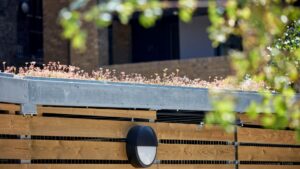
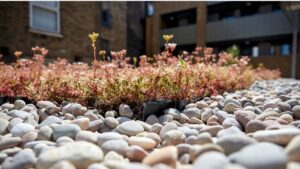
For Bellsure, green-roof cycle shelters are one way to help clients deliver both robust cycle infrastructure and credible biodiversity gains, while also supporting carbon reduction and sustainable drainage in a single package. By adding a sedum or wildflower roof to a functional piece of infrastructure, you:
- Protect bikes from the elements and improve the end-user experience
- Introduce flowering plants that provide nectar and habitat for bees, butterflies and other pollinators
- Help reduce urban heat gain and manage rainwater on hard-landscaped sites
- Support SuDS (Sustainable Drainage Systems) requirements
- Improve the visual quality of cycle storage, bin stores or compounds in sensitive locations
Our low-maintenance systems are designed to be drought-tolerant and require no irrigation, which keeps maintenance demands low while still providing genuine ecological value. At the same time, the shelters themselves are engineered to do the basics extremely well – secure cycle parking, weather protection and layouts that deliver a smooth user experience for residents and visitors.
A small intervention with wider benefits
Of course, we’re not suggesting green roofs can avert climate change or singlehandedly solve the pollination problem. But as part of a wider strategy, they can play a useful supporting role.
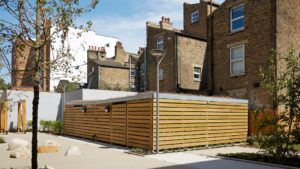
At Manor Place Depot in London, for example, Bellsure supplied cycle shelters and associated infrastructure for a mixed-use redevelopment on a constrained urban site. The brief combined practical requirements – secure cycle storage, robust materials and a tidy visual appearance – with a desire to enhance the site’s environmental credentials, support urban greening and contribute to wider sustainability goals. Green-roof shelters allowed the design team to do all of these things, supporting the project’s active travel ambitions while adding visible greenery and habitat into a courtyard setting.
Designed for real projects, not just good intentions
What matters most to clients is that these solutions work in the real world. That means:
- Designing within genuine site constraints – traffic flow, access routes and adjacent uses
- Coordinating with bin stores, plant, mailboxes and wider street furniture
- Delivering structures that are durable, fully compliant and straightforward to maintain
Because we design, manufacture and (where required) install shelters, cycle parking and associated street furniture, we can take responsibility for the whole journey from drawings to handover. Green-roof solutions can be integrated into that process, not treated as an afterthought.
A thoughtful step in the right direction
No single intervention will transform a development into a biodiversity hotspot. But in an era where pollinators are under pressure and developers are asked to do more with less space, it makes sense to choose solutions that are quietly more sustainable by nature.
Green-roof cycle shelters can help:
- Promote cycling and active travel with well-designed infrastructure
- Add meaningful habitat and visual softness to dense urban environments
- Support urban greening, carbon reduction and biodiversity net gain objectives
- Demonstrate that sustainability and usability have been considered in equal measure
If you’re exploring ways to combine high-quality cycle storage with small but tangible biodiversity benefits, we’d be happy to talk through what’s possible. With Bellsure on your next project, you can be sure our pollinators haven’t been overlooked.
https://sheffield.ac.uk/news/urbanisation-linked-43-cent-drop-pollinating-insects