
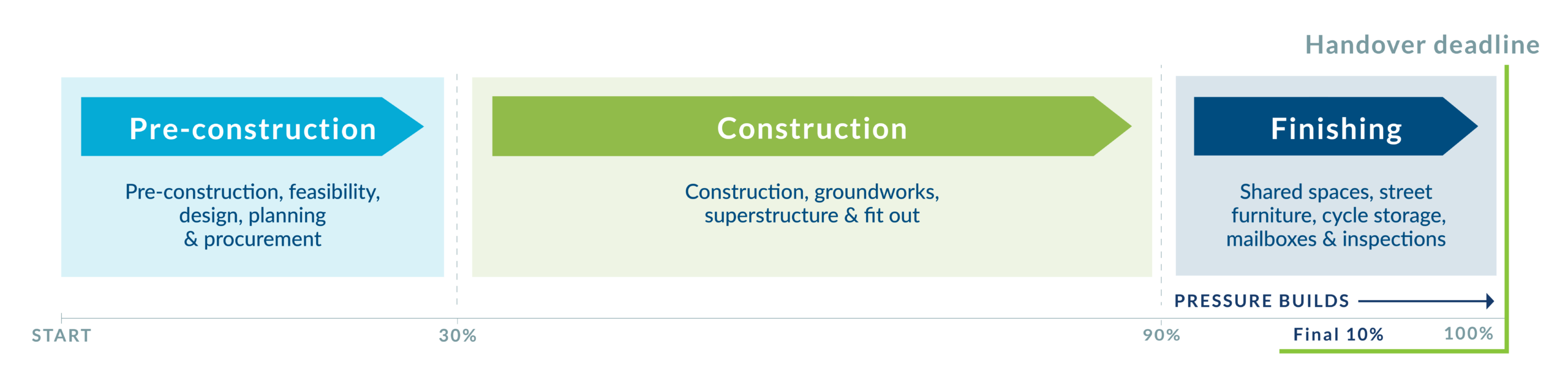
Every major development project has a moment when the pressure mounts – the core structure is up but budgets and handover deadlines are really tight, stakeholders are watching and suddenly, the details that once felt peripheral are in the spotlight.
Construction project timeline (illustrative)
Cycle parking, shelters, lockers, mailboxes, bollards, bins, benches and end-of-journey facilities are rarely headline items in the early stages of infrastructure design. But these are the things that often have the biggest impact on the day-to-day user experience of shared public spaces.
For developers and project teams, the process of delivering and installing the street furniture that makes our shared spaces functional, compliant and genuinely usable, can be a major headache – as they struggle to hit agreed timescales, budgets and quality standards during the final stages.
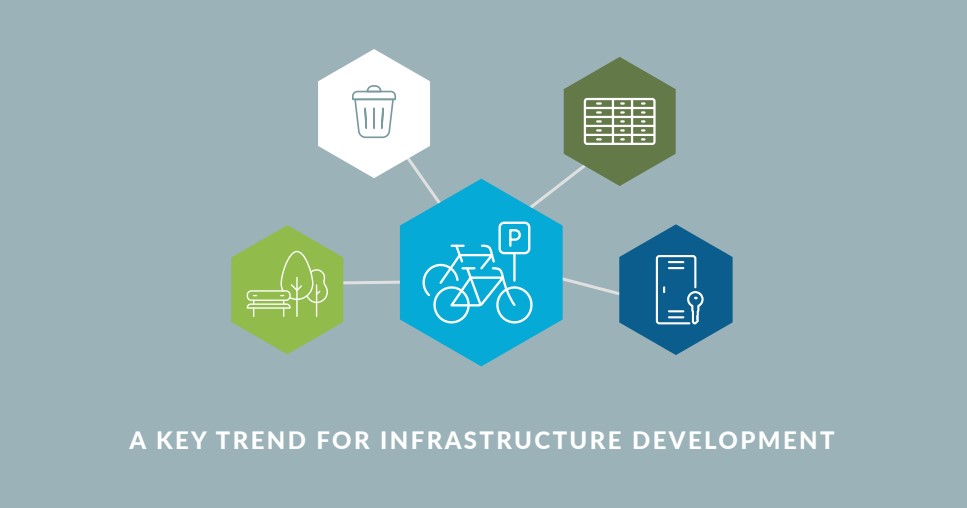
As the population continues to grow, a more sustainable transport strategy is heavily dependent on cycling and active travel becoming central to town and infrastructure planning – and local authorities are increasingly demanding secure, convenient and well-designed cycle storage provision in new developments.
In London, for example, cycle storage numbers are embedded in the London Plan with qualitative requirements linked to the London Cycling Design Standards.
The message is clear – effective cycle storage and end-of-journey infrastructure is no longer a ‘nice-to-have’ indicator of a development’s usability and future-readiness. It’s a highly visible ‘must have’ deliverable that is often not properly or fully considered until the later stages of project delivery.
The common pitfalls at the sharp end of delivery
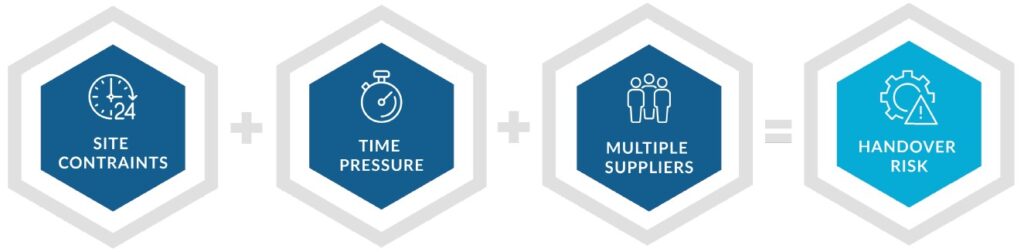
As the handover deadline approaches, contractors really start to feel the squeeze. Here are just some of the issues we come across:
- The mismatch between spec and reality
Even a robust, compliant product can fail to deliver the intended outcome if it hasn’t been matched to the specific site and user context. Ceiling heights, aisle widths, pipework, doorways and access routes can all affect feasibility of specific designs and compromise capacity or usability.
- Late design decisions
When cycle storage or end-of-journey facilities are treated as ‘add-ons’, they can be specified too late to secure the best-fit solution – increasing risk that the compromise will fail to meet user expectations. - Overlapping responsibilities
Finishing-stage infrastructure often involves multiple suppliers, which creates gaps in accountability. That can lead to delays caused by sequencing conflicts, inconsistent communication between teams, or avoidable snags during handover.
None of this is unusual, it’s just the reality of complex, live projects under time pressure. But it’s also why the best outcomes typically come from developers and contractors who treat these elements as an engineered solution, not an off-the-shelf catalogue item.
What good looks like – the Bellsure guide to best practice
If you want to protect the end-user experience and keep delivery calm and controlled in the final stages before handover, we’ve found that a few practical principles consistently make the difference and help developers, QS teams and designers to avoid late-stage compromises.
Don’t design for numbers, design for usability
If your project is serious about encouraging sustainable travel, it’s important to ensure the best possible user experience for cyclists – where the experience is poor, uptake of cycling drops and the space becomes underused – exactly what stakeholders want to avoid.
Good design should consider visibility and personal safety, adequate space and ease of access, protection from the elements where needed, sensible traffic flow and secure locking. If you get this right, you can actively raise the perceived standard of the development.
Plan early and validate on site
Cycle storage and end-of-journey spaces are most successful when they’re considered early enough to influence layout – not just fit into it. And that means validating capacity targets against the site footprint – looking at ceiling heights, aisle widths, access routes, turning space and clearance, as well as conflicts with services or plant.
If your supplier or sub contractor hasn’t carried out a thorough site assessment, then you’re likely to experience problems on installation and sometimes that can mean last-minute redesigns and delays.
Choose partners who own the outcome
When products, drawings and installation are spread across multiple contractors, gaps in accountability appear, miscommunication can happen – and the project is exposed to risk. That’s why it makes sense to engage a supply-and-install partner, creating a single line of responsibility and clearer sequencing. Leaving project managers with fewer moving parts to manage, more control and a more predictable route to handover.
The common thread here, is confidence. Not in any abstract sense – but the practical kind of confidence that comes from knowing the right solution has been designed for the site you actually have, installed by a team who understands your deadlines, and delivered by a partner who will act like they own the finish line too.

How Bellsure can help
In an industry where the basics are not always executed well, Bellsure delivers confidence to every project through dependable delivery, honest communication and proactive, expert support.
We design, manufacture and install high-quality cycle parking, shelters, street furniture, mailboxes, compartment lockers and end-of-journey infrastructure – the practical finishing touches that make shared spaces work.
And crucially, our approach is built around removing friction during delivery:
- Free cycle parking space planning to maximise capacity and usability while aligning with relevant standards, including London Cycle Design Standards and council-specific requirements
- In-house CAD and design that can reshape solutions quickly when layouts or requirements change
- Proactive site visits to spot issues early
- Fast, clear communication with quick-turnaround answers and quotes
Countless case studies prove our approach works – not least because we support our clients with the practical realities of on-site delivery – not just theoretical design.
We take ownership of the detail that can derail late-stage delivery
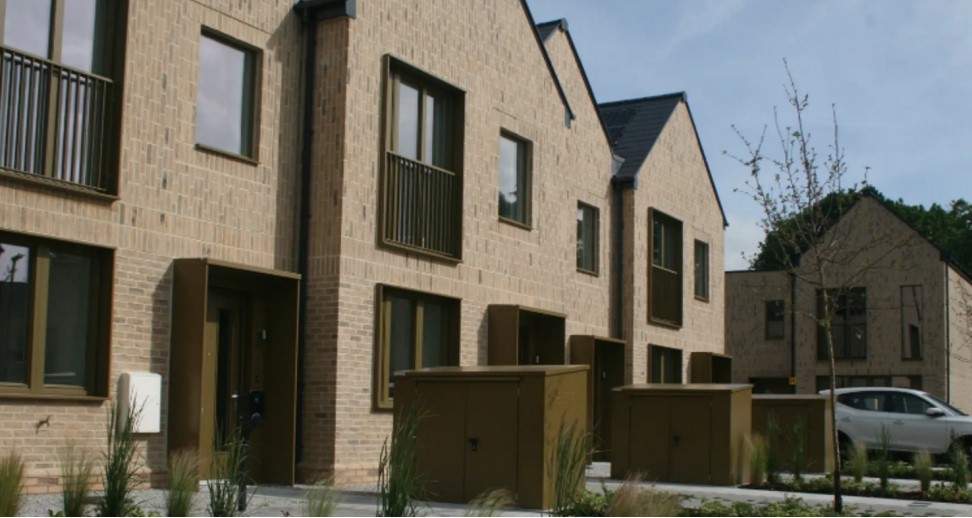
Bellsure was commissioned to supply and install secure cycle storage for 112 houses on North West Eddington Avenue in Eddington, Cambridge – a major development designed as a sustainable, mixed-use neighbourhood with a clear emphasis on walking, cycling and public transport.
The project also required a site-specific solution: twelve houses needed storage for four bikes rather than the standard three, without increasing locker depth (as the units had to sit alongside garden paths). By adapting our standard product, we created a unit double the length, enabling storage for up to six cycles for these homes while maintaining the architect’s specification, matching the site’s design language. With no compromise on capacity, security or usability.